Message-Oriented Middleware (MOM) is a software system that unlike applications can be in touch by sending messages. It allows data to move between programs without making them wait. This makes applications work independently and secure smooth communication in a give out environment.
In a MOM system, messages travel through a message queue, where they are stored until the receiving application is ready. This asynchronous approach steer clear of hold up, supports large workloads, and helps systems stay good even when one part is for now unavailable.
MOM in software clarifies complex application interplay by acting as an overpass between programs. It ensures that messages are conveyed securely, supports different communication patterns, and allows developers to build workable and scalable systems without hard work.
Message-Oriented Middleware
Message-Oriented Middleware (MOM) is a software that allows applications to communicate by sending messages through a message queue. It supports asynchronous communication, letting programs work independently and upgrade performance in distributed systems without waiting for instant responses.
In a MOM system, messages are stored safely in a queue until the receiving application is ready. This ensures good message delivery and helps manage high workloads. It also allows decoupled communication, making applications easier to update and maintain over time.
Message-Oriented Middleware simplifies blending between applications and supports different messaging patterns like point-to-point and publish-subscribe. It provides secure communication, monitors system performance, and scales dynamically, enabling smooth and efficient operation across act systems.
Message queues serve as the core part for enabling non-blocking communication in a MOM system.
- Asynchronous Messaging: Lets applications send and receive messages independently, improving speed and reducing delays in distributed systems.
- Reliable Delivery: Uses message queues to ensure messages are stored, retried, or redirected if errors occur.
- Flexible Integration: Supports multiple communication patterns and connects diverse systems securely for smooth enterprise messaging.
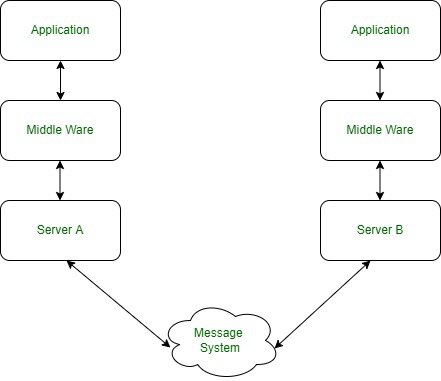
Block Representation of Middleware
Features and Capabilities
- Unified Messaging: Provides a consistent messaging infrastructure that supports point-to-point and publish-subscribe communication, helping different applications work together smoothly.
- Provisioning and Monitoring: Offers tools to manage system performance, allocate resources, and monitor message files in real time.
- Dynamic Scaling: Automatically adjusts resources to handle increased workloads, ensuring logical performance across distributed systems.
- Management and Control Tools: Includes administrative tools for configuring and controlling message flows, queues, and system components usefully.
- Flexible Service Quality: Supports configurable delivery guarantees like at-most-once, at-least-once, and exactly-once, matching application requirements.
- Secure Communication: Ensures data protection with encryption, authentication, and consent, preventing lawful access.
- Integration with Other Tools: Connects seamlessly with databases, APIs, and cloud services, promoting workflow automation and better system interoperability.
Structure and working of the Message Queue in MOM:
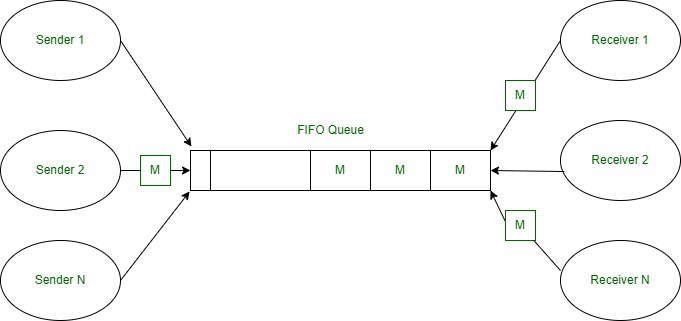
This is the process of how a message queue operates within a MOM system:
- Message Creation:
The producer application generates a message with a payload and metadata, including headers, right of now, and timestamp, preparing it for secure and order message-put controller delivery. - Message Sending:
The producer sends the message to the message queue using the MOM infrastructure, ensuring it enters the asynchronous communication system reliably. - Queueing Mechanism:
The message queue for now stores messages until the receiving application is ready, following FIFO (First-In-First-Out) or right of way-based handling. - Message Consumption:
The consumer application retrieves and processes the message, allowing decoupled communication between distributed components without blocking operations. - Acknowledgment and Removal:
After successful processing, the consumer sends an acknowledgment, and the message is removed from the queue, ensuring system consistency and reliability. - Retry and Error Handling:
If delivery or processing fails, the message can be retried or sent to a dead-letter file, providing strong error management in MOM systems.
In a MOM system, the message queue acts as a storage buffer for messages. It holds data until the receiving application is ready, ensuring asynchronous communication and smooth give out system operation without hold up.
The message file supports good message delivery by handling retries, acknowledgments, and error management. It allows applications to communicate independently, improving system scalability, performance, and overall workflow order.
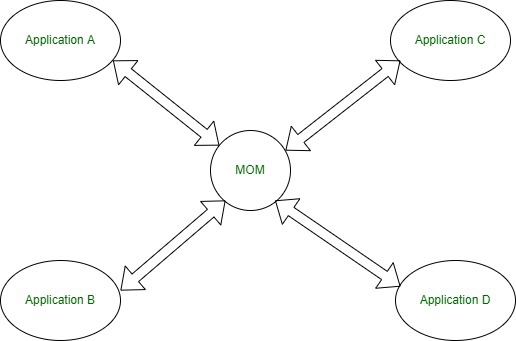
By using message-oriented middleware, the queue decouples applications, supports multiple messaging patterns like point-to-point and publish-subscribe, and merges with venture systems, ensuring secure and flexible communication across distributed applications.
The Architecture of Message Oriented Middleware
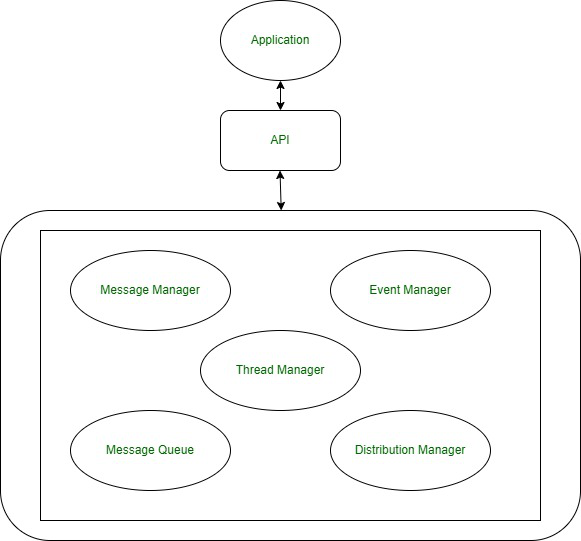
- Application Layer: The application is the end-user or business logic component that sends and receives messages through the MOM system, enabling decoupled communication across distributed applications.
- API Interface: The API acts as a bridge between the application and MOM infrastructure, allowing developers to send, receive, and process messages without handling the underlying problem.
- Message Manager: The message manager creates, formats, and routes messages, ensuring they follow the expected structure and reach the correct queues or stop reliably.
- Event Manager: The event manager detects, shows, and responds to system or application events, such as message arrival or system errors, helping maintain smooth operation and workflow automation.
- Thread Manager: The thread manager handles multithreading within the MOM system, optimizing resource use and ensuring logical processing of multiple messages at once.
- Message Queue: The message queue stores messages until they are eaten up, supporting asynchronous communication and enabling reliable delivery between sending and receiving applications.
- Distribution Manager: The distribution manager controls how messages are delivered to one or more recipients, manages load balancing, and supports point-to-point or publish-subscribe messaging models.
Types of middleware
- Database Middleware: Enables applications to interact with databases efficiently by managing connections, queries, and transactions, ensuring smooth data access and reliable integration across distributed systems.
- Application Server Middleware: Provides an environment to run and manage application logic between clients and backend systems, supporting scalability, resource management, and seamless enterprise integration.
- Messaging Middleware: smooth communication between distributed systems by sending and receiving messages through queues, supporting asynchronous communication and decoupled application interactions.
- Message-Oriented Middleware (MOM): Supports asynchronous messaging via message queues, enabling reliable delivery, loose coupling, and open communication between different software components and applications.
- Transaction Processing Middleware: Manages distributed transactions, ensuring consistency, reliability, and rollback in case of failures, making it key for act systems and reproving applications.
Roles of message-oriented middleware
- Distributes messages across complex IT systems efficiently.
- Acts as a connector between different applications or platforms.
- Facilitates message delivery across various IT organizations reliably.
- Supports multi-platform integration, ensuring compatibility across different operating systems.
- Enables communication between multiple software components seamlessly.
- Links front-end and back-end systems, providing smooth enterprise integration.
- Integrates diverse technologies for message origination and delivery.
- Manages workflow between distributed applications for efficient message processing.
Example
Message-oriented middleware (MOM) plays a vital role in fasten different applications within an organization. It ensures good message delivery, supports multiple party lines, and enables perfect communication between front-end and back-end systems, improving overall issue system performance.
By managing message flows, MOM allows software to operate independently while maintaining decoupled communication. It also integrates diverse technologies and ensures smooth venture messaging, helping businesses maintain workflow automation and handle complex IT environments efficiently.
Advantages
- Loose Coupling: Components work independently, allowing easy updates and flexibility in distributed applications without affecting other systems.
- Scalability: hold increased workloads efficiently, ensuring message delivery and system performance remain consistent across enterprise systems.
- Fast Performance: Supports asynchronous messaging, enabling quick response times and smooth communication between different software components.
- Reliability: Ensures messages are delivered right, even in complex IT environments, reducing the risk of failures or data loss.
- High Availability: Remains operational with minimal downtime, supporting continuous workflow automation and prime integration across applications.
Disadvantage
- Requires Additional Infrastructure: MOM needs extra components like message queues and brokers, which can increase system complexity and maintenance effort.
- Poor Programming Abstraction: It can be difficult to express the messaging logic cleanly within application code, making development more complex.
- One-to-One Communication Limitation: The queue-based system primarily supports direct sender-receiver interaction, which can limit some distributed system workflows.
- Platform Limitations: Certain operating systems or environments may not fully support MOM discharge, control enterprise system integration flexibility.
Conclusion
In conclusion, Message-Oriented Middleware (MOM) is a powerful software infrastructure that bans reliable and asynchronous communication between applications in issue systems. By using message queues, MOM ensures decoupled communication, secure message delivery, and logical workflow automation. Its planning, including the API, message manager, event manager, and distribution manager, supports flexible fusing and scalability across exercise systems.
While it offers advantages like loose coupling, reliability, and high availability, it also has control such as requiring extra piece and platform reduction. Overall, MOM simplifies complex application interplay, improves performance, and supports robust venture messaging.
FAQs
What is Message-Oriented Middleware (MOM)?
MOM is software that enables asynchronous communication between applications using message lines, ensuring good data delivery and decoupled interaction in issue systems.
How does a message queue work in MOM?
A message queue for now stores messages until the collect application is ready, supporting asynchronous messaging, good delivery, and smooth communication across give out applications.
What are the main features of MOM?
MOM quality includes mix messaging, dynamic scaling, secure communication, management tools, and blending with other systems, allowing efficient venture messaging.
What are the advantages of using MOM?
MOM leads include loose coupling, scalability, fast performance, reliability, and high availability, which refine workflow automation and system efficiency in issue environments.
What are the disadvantages of MOM?
MOM disadvantages include needing extra infrastructure, poor programming distraction, one-to-one communication control, and platform cut, which can increase problems in move integration.
Read More Articles: Msgsword